Russula heterophylla (Fr.) Fr.
Grüner Speisetäubling, Russule verte, Greasy Green Brittlegill.
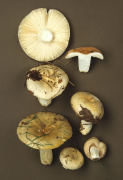
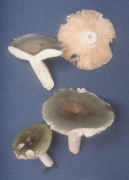
Cap 5–10cm across, almost globose at first, later flattening and with a depression, various shades of green, brown or even ochre or (var. chlora) yellow, fairly firm, smooth or with radial branching veins. Stem 30–60 x 10–30mm, white, browning, firm, salmon when rubbed with an iron salt (this distinguishes it from R. cyanoxantha var. peltereaui). Flesh white. Taste mild. Gills slightly decurrent at first, later adnexed, white to very pale cream, very closely spaced, thin, from somewhat flexible with an oily feel to somewhat brittle. Spore print whitish (A). Spores almost globose to elliptic or pear-shaped, with warts 0.2–0.6µ high, mostly isolated, occasionally two to three joined together or connected by a line, 5–7 x 4–6µ (smallest in genus.) Cap hyphae terminations tapering or sometimes prolonged into a narrow, thick-walled hair, supporting cells rectangular or inflated; cap cystidia club-shaped, cylindrical, spindle-shaped or tapering. Habitat under broad-leaved trees. Season summer to early autumn. Occasional (var. chlora rare). Distribution, America and Europe. Edible. (Never eat any mushroom until you are certain it is edible as many are poisonous and some are deadly poisonous.) |